How to choose a reliable payment method for ads and online services
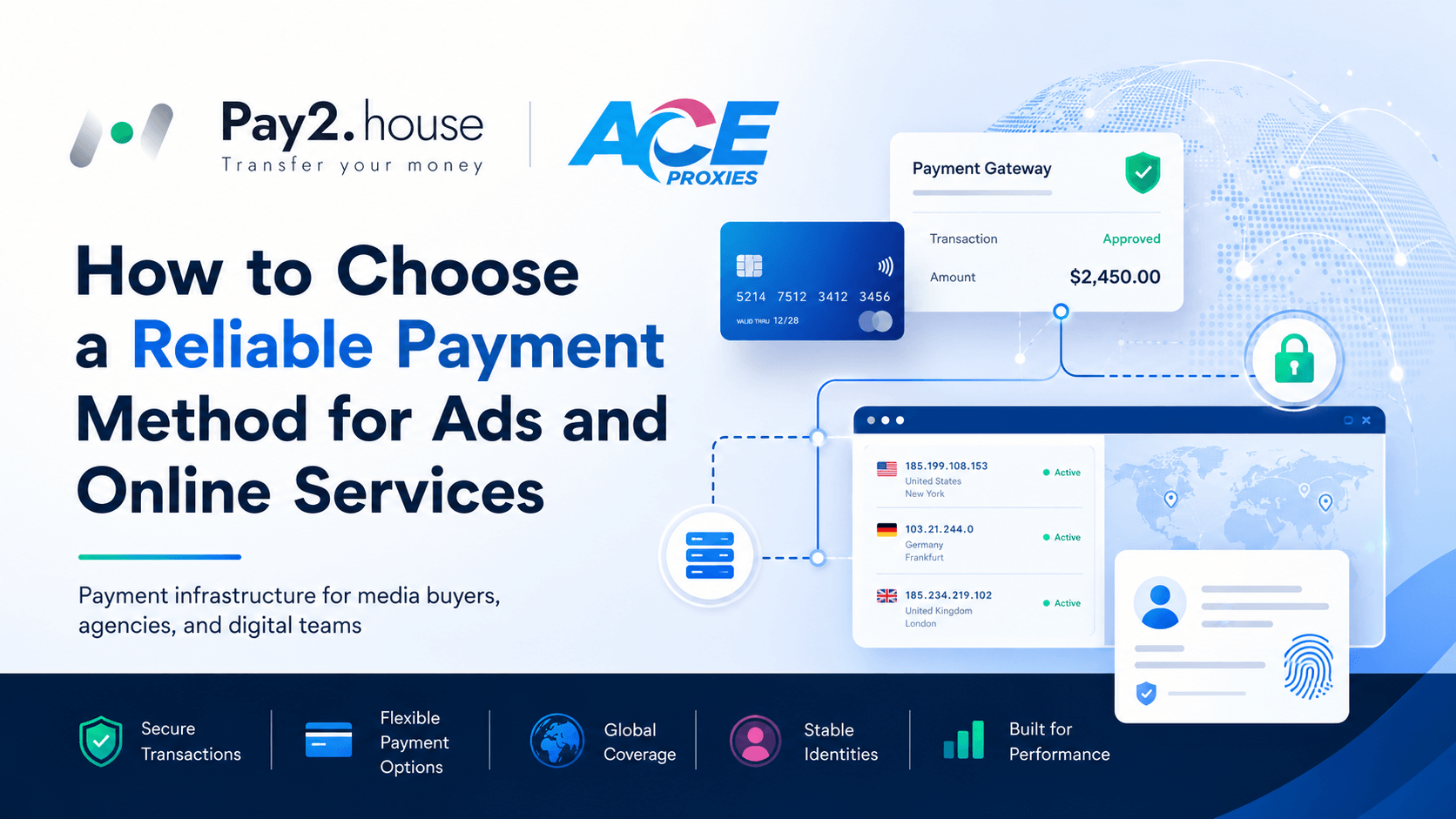
In arbitrage and in teams that constantly work with ad accounts, a payment solution is not just a tool for processing charges. It is part of the overall infrastructure: together with proxies, antidetect browsers, accounts, and working services, it affects launch speed, budget control, and the stability of the entire system.
Even if a team has a well-built setup in terms of IPs, profiles, and access, a weak payment layer still creates problems. Payment delays, expense confusion, or inconvenient card issuing quickly turn into extra operational workload and start slowing down ad launches and service maintenance.
Why payment matters more now
In the past, many people were fine with a single payment tool for almost all tasks. Now arbitrage teams, media buyers, and agencies simultaneously spend on ad accounts, trackers, antidetect browsers, hosting, domains, SaaS subscriptions, and other working services, so a single card is rarely convenient anymore.
In this setup, it is not only about making payments, but also about how easy it is to control budgets across different projects and funnels. If a payment system does not help separate expenses and quickly issue dedicated cards for tasks, accounting chaos starts interfering with both testing and scaling.
What matters when choosing
When selecting a payment solution, it is useful to look not only at marketing claims, but also at practical criteria - these determine how comfortable it is to use the tool daily.
| Criterion | Why it matters |
|---|---|
| Payment stability | Helps avoid interruptions when paying for ads and services. |
| Fast onboarding | Allows quick card issuance and an immediate start without delays. |
| Easy top-ups | Simplifies regular funding and does not slow down campaign launches. |
| Expense separation | Helps keep separate budgets for different accounts, projects, and funnels. |
| Suitable currency and billing | Reduces mismatches when working with ad platforms. |
A good payment solution in this logic is a tool that does not require constant attention. The less time a team spends manually managing payments, the easier it is to focus on testing, analytics, and scaling.
Where Pay2.House fits in such a setup
Such solutions are most in demand where expenses are distributed across multiple tasks and require clear control. This is not only about large agencies - even small teams or individuals managing several projects at once quickly notice the difference between a generic payment method and a dedicated tool.
Most typical use cases include:
- paying for ad campaigns in Facebook Ads, Google Ads, TikTok Ads, and other platforms
- paying for SaaS subscriptions and working services
- expenses for hosting, domains, analytics and automation tools
- separating payments by clients, departments, or directions
As a result, companies get not just a way to pay, but a more manageable expense structure. This is especially important where advertising activity runs continuously and any friction in payments gradually turns into noticeable operational overhead.
How this connects to overall infrastructure
A payment solution alone does not fix a setup if everything else is built poorly. But if it is integrated into a proper system, it creates a strong effect. In arbitrage and related workflows, it is always important that:
- accounts are isolated
- IPs and profiles do not conflict
- payment data does not look like a random mix
- expenses follow a clear structure
In other words, the payment layer should not be a separate workaround, but part of the overall configuration.
In practice, this means a simple thing: when a team has a reliable way to issue cards, properly distribute spending across tasks, and avoid chaos, scaling becomes significantly easier.
The role of proxies in media buying
Another important part of the setup is the quality of the network connection used when accessing ad accounts, antidetect browsers, dashboards, and online services.
For media buyers, affiliate teams, and agencies managing multiple accounts, proxies are part of the operating system.
A reliable proxy setup helps create consistency and separation between workflows. For example, one account may need a stable IP and dedicated browser profile, while another task may require rotating residential IPs for research, testing, or geo-checking.
Ace Proxies provides dedicated private proxies, static residential proxies, rotating residential proxies, and mobile 4G/5G proxy solutions with HTTP, HTTPS, and SOCKS5 support. Dedicated static options offer 99% uptime and unlimited bandwidth, while rotating and mobile options support workflows that require flexibility, geo-testing, or carrier-network IPs.
The combination of a stable proxy setup and a convenient payment tool is especially useful for teams scaling ads or managing client projects across different GEOs.
Both components help reduce operational friction and remove unnecessary points of failure from the workflow.
How to evaluate a service in practice
In theory, almost any service may look suitable - the real picture appears only in actual use. Therefore, before full migration, it is useful to test the basic flow: issuing a tool, topping up, first charge, and repeated operations.
Key things to check during testing:
- Startup speed - how quickly initial steps can be completed
- Interface convenience - how clear the dashboard is
- Expense control - whether transactions are easy to track in real time
- Flexibility - whether the tool can be used in multiple scenarios without confusion
These details define the real usefulness of a solution.
Typical mistakes
Looking only at price
The most common mistake is choosing the cheapest option. But a cheap payment solution that constantly creates issues ends up costing more than any fee. Team time also has a price.
Mixing all expenses into one flow
When ads, services, tests, and related costs go through the same channel, accounting quickly becomes messy. It becomes difficult to understand what actually works and what simply burns the budget.
Not testing in advance
A major mistake is immediately moving significant funds into an untested tool. The correct approach is to first run small transactions and see how the service behaves in real conditions.
Ignoring usability
If the internal system is inconvenient, extra time will still be spent. In arbitrage, time is often the hidden cost.
What a team gets in the end
If a payment system is chosen correctly, it is noticeable not only at the level of individual transactions. The team gains predictability, reduces manual operations, and scales processes more easily.
Benefits typically appear in several areas:
- less time spent on payment-related routine
- easier allocation of expenses across tasks and projects
- simpler onboarding of new services and campaign launches
- better organization of financial operations in digital workflows
In the long term, this affects not only team comfort but also the overall stability of processes. Pay2.House can be viewed in this context as a tool for those who need a convenient payment infrastructure for regular tasks without unnecessary complexity.