
Edge-Aware Scraping 2025: HTTP/3, ECH, DoH or DoQ and JA4
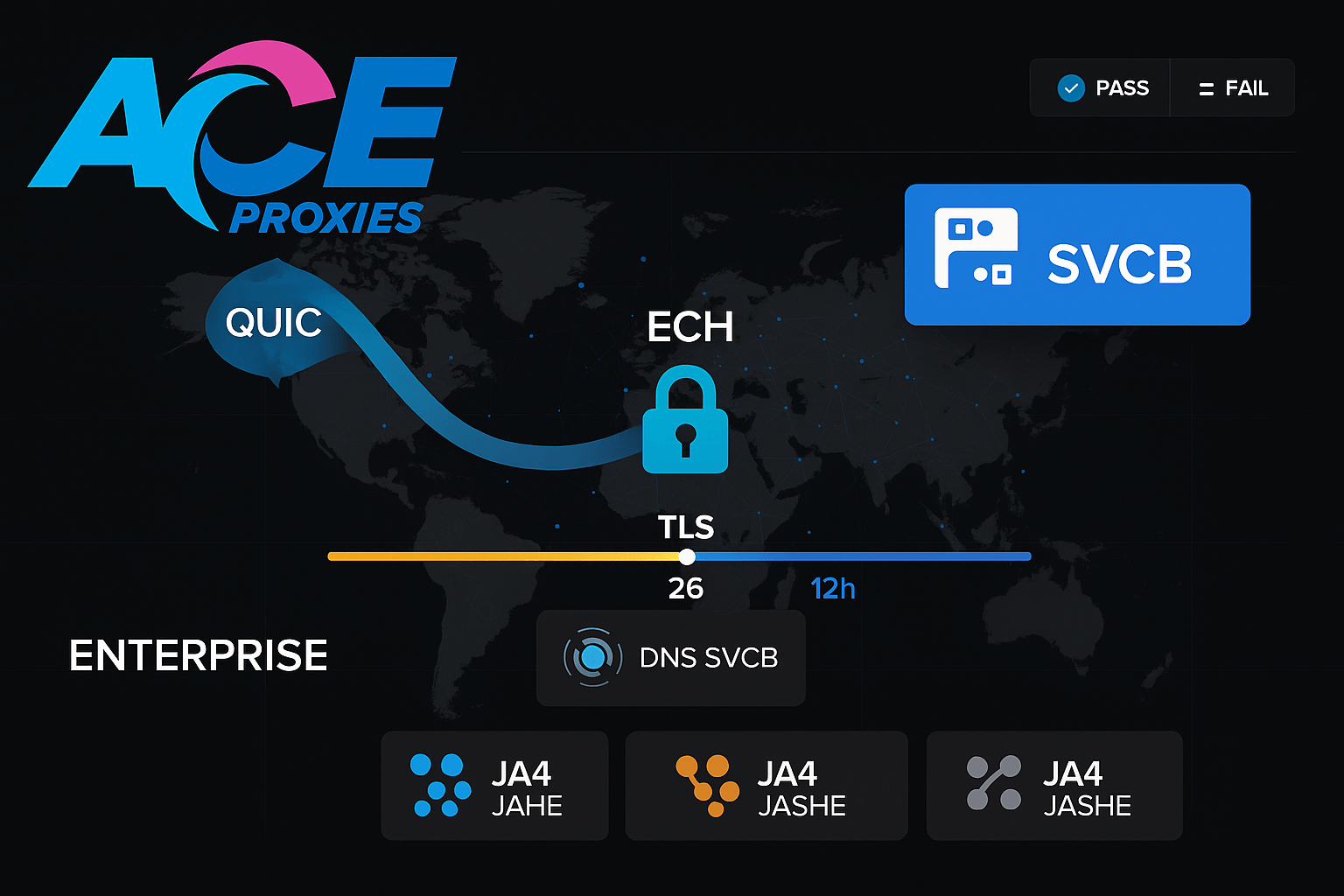
Scraping used to be a simple formula: more IPs, more retries, more brute force. That approach does not survive in 2025. The first barriers live at the edge, not the DOM. Your DNS behavior, TLS patterns, HTTP version, resolver choice, and connection consistency form a fingerprint before you see any content. If that fingerprint fails to resemble modern user traffic, challenge rates rise, retries multiply, and your costs shift from bandwidth to wasted compute.
This field guide shows how to understand and control edge signals such as HTTP/3, QUIC, ECH, DoH, DoQ, and JA4. It also shows how to combine these with session realism and correct proxy lane selection so you can avoid unnecessary browser escalation and reduce both friction and cost.
The Edge Is the First Gate
Modern defenses correlate low-level transport details long before DOM activity is analyzed. Protocol version, ALPN choices, TLS extension ordering, DNS resolver fingerprints, and response timing all contribute to a behavioral profile. If these factors drift, you will see more throttles, more puzzles, and more tail-latency spikes.
The new mindset: think less about IP quantity and more about transport believability. IP diversity is still important, but it cannot compensate for inconsistent edge behavior.
Ace Proxies helps by ensuring that your chosen behavior passes through a clean, stable, reputation-safe network.
HTTP/3 or QUIC: When Your Client Speaks the Wrong Dialect
QUIC shortens handshakes and behaves differently on lossy paths. When a site prefers h3, using h1.1 or h2 is not an automatic block, but it becomes one more oddity in your profile.
What to do:
- Probe each domain during warm-up and record the protocol versions it supports
- Prefer h3 when it is stable; fall back to h2 when needed
- Stabilize header order across redirects and retries
- Keep connections alive when possible
Advanced levers you control at the client:
- 0-RTT resumption for faster reconnects when safe
- QUIC connection migration for long-running sessions
- Improved congestion control on high-latency routes
Testing tip:
Run an h3 vs h2 comparison for a route for one week. Track challenge rate, retries per success, and p95 latency. Pick the winner based on data.
Ace Proxies ensures your chosen protocol path remains stable and predictable.
ECH: Encrypted Client Hello in Practice
ECH hides the hostname inside the TLS handshake. This moves detection from SNI-based logic toward your overall behavior.
Your playbook:
- Use ECH-aware DNS that supports HTTPS and SVCB records
- Cache records to avoid inconsistent lookups
- Fall back without triggering retry storms
- Maintain identity consistency across TLS, ALPN, and header order
Your TLS decisions will perform more reliably when carried over stable, clean IPs.
DoH and DoQ: Your Resolver Is a Fingerprint
DNS resolution is now part of client identity. Jumping between resolvers or behaving inconsistently per region creates detectable noise.
Best practices:
- Use a consistent DoH or DoQ resolver strategy per route
- Cache aggressively to reduce upstream chatter
- Respect SVCB and HTTPS records for correct protocol choices
Better DNS hygiene improves time to first byte and reduces retry volume.
Ace Proxies provides the stable routing environment that makes resolver consistency achievable.
JA4 vs Randomization: Consistency Wins
JA4 summarizes transport traits into compact fingerprints. If your retries alter TLS extensions, header order, or ALPN, you look like multiple clients trying the same door.
Your rules:
- Choose a JA4-consistent template per proxy lane
- Avoid changing device or browser identity mid-session
- Keep header order fixed
- Throttle intentionally instead of hammering retries
Stable IPs from Ace Proxies allow your JA4 consistency to persist across sessions.
Lane Design for the Edge Era
Different workloads require different lanes.
Datacenter Proxies
Ideal for permitted, high-volume public pages. When combined with disciplined h3 or h2 usage, they deliver low cost per success.
Rotating Residential Proxies
Best for geo-sensitive catalogs and rate distribution across diverse consumer networks.
Static Residential (ISP) Proxies
Best for long-lived sessions, accounts, partner flows, and research tasks.
The decision: choose the lane that makes your transport story the most believable.
Session Realism Meets Transport Reality
Edge parity is only half the solution. You must behave like a person.
Use these client-side techniques:
- Sticky sessions with defined lifetimes
- Locale coherence: IP region, Accept-Language, and time zone aligned
- Realistic pacing with controlled bursts
- Gradual warm-ups when switching lanes
- Retry labels by cause for correct tuning
Ace Proxies delivers the clean exits that make realistic sessions viable.
The Weekly Edge-Signals Dashboard
Build a dashboard your team will actually use:
- Protocol split: percentage of h3, h2, and h1.1
- Challenge rate by protocol
- JA4 drift percentage
- Resolver consistency and cache hit ratio
- p95 latency
- Retries per success
- Top five failure causes
Make changes one at a time. Hold steady for a week and measure the delta.
Implementation Sprint: 10-Step Edge Readiness Plan
Day 1 to 2: Instrumentation
1. Mark success after parsing
2. Log protocol, ALPN, TLS errors, resolver, and lane
3. Freeze header order templates per lane
Day 3 to 4: Protocol and DNS
4. Warm up h3 where offered; fall back sensibly
5. Use consistent DoH or DoQ
6. Detect ECH-related records and add fail-open logic
Day 5 to 7: Session and Pacing
7. Implement sticky session windows
8. Align locale settings across layers
9. Add concurrency limits and realistic think time
10. Build your dashboard and complete your first review
Expected week two improvements: fewer retries, smoother latency, and clearer diagnostics.
When to Escalate to Browser APIs
Escalate only when:
- Multi-step flows fail under non-browser clients
- The site depends heavily on JavaScript
- Transport and session parity are correct but challenges persist
Scope the routes carefully and downgrade when possible.
Performance Gains Without Folklore
You can achieve major improvements without chasing mythical fingerprints:
- Efficient connection reuse
- Backoff with jitter
- DNS cache discipline
- Predictable pacing
- Stable transport and session templates
A reliable proxy network amplifies the benefits of these improvements.
FAQ
Q: Should we force HTTP/3 everywhere?
No. Probe and measure per origin.
Q: Will ECH break pipelines?
Not if you handle it gracefully and maintain consistent behavior.
Q: Is header randomization still useful?
No. Humans are consistent.
Q: Do we need a browser by default?
No. Use it only when needed.
Q: How often should we rotate IPs?
Rotate based on route behavior, not arbitrary timers.
Your Next Move
- Treat transport parity as a primary KPI
- Build realistic session behavior
- Review edge metrics weekly
- Choose the simplest lane that fits the route
- Escalate to browser lanes only when necessary
Default lane: Datacenter Proxies
For geo diversity: Rotating Residential Proxies
For continuity: Static Residential Proxies
Scrape with Confidence – Explore Ace Proxies’ product suite