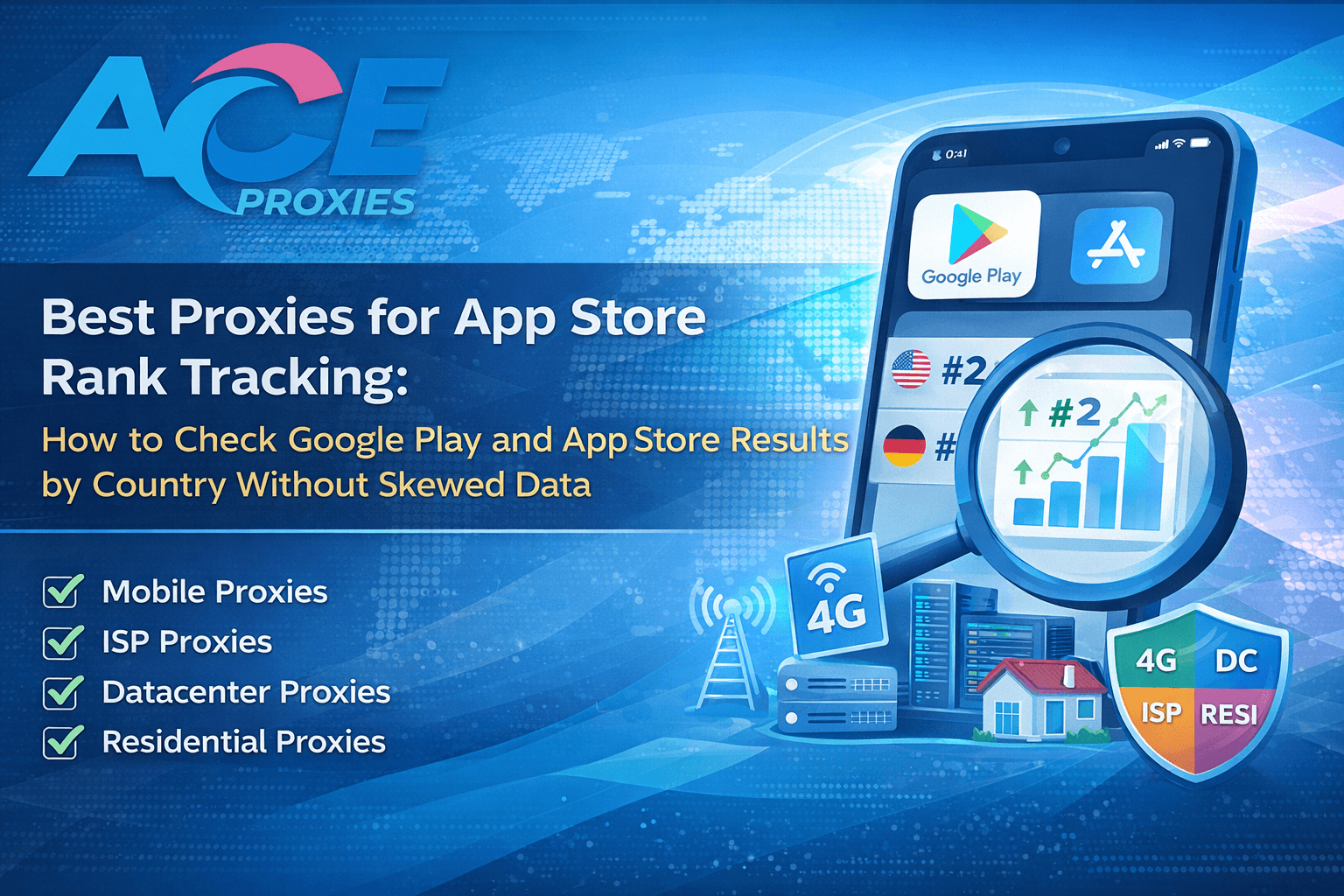
Best Proxies for App Store Rank Tracking: How to Check Google Play and App Store Results by Country Without Skewed Data
Introduction
Most App Store Optimization (ASO) teams do not actually have a rank-tracking problem. They have a context problem.
A keyword can look stable on one device and completely different on another because Apple and Google do not serve one universal store view. Apple lets developers choose exactly where an app is available across 175 regions, noting that a customer’s Apple Account country determines which App Store they see. Similarly, Google Play supports strict country targeting, where availability is based on the user’s registered Play country—not just their current physical location.
That means celebrating a "Rank #3" position is completely meaningless unless you can answer: Rank #3 for which store, which country, which language, and which network identity?
Google allows developers to create up to 50 custom store listings for different regions. Apple’s metadata language dynamically changes based on location, device settings, and primary app languages. Therefore, the real job of ASO isn't just collecting positions—it is collecting positions from a believable, repeatable market identity.
That is where your proxy architecture stops being a generic "unblocking" tool and becomes the foundation of your measurement quality. For accurate reporting, the winning setup requires a multi-lane system. You need rotating residential proxies for ASO discovery, mobile proxies for high-fidelity app checks, and static residential proxies for benchmark reporting.
This guide breaks down the best proxies for app store rank tracking, explains why standard scraping setups return false positives, and shows you how to build a highly accurate validation stack using Ace Proxies.
Why App Store Rank Tracking Is Harder Than Regular SERP Tracking
Standard web SERP (Search Engine Results Page) tracking is already messy. App store tracking is substantially harder because the storefront itself acts as a closed, highly personalized environment.
On Apple’s side, developers can publish to all 175 App Store regions or just a select few. The customer’s Apple Account country dictates their commercial market. On Google Play, country targeting is tied to the user’s Play account profile, not simply where their IP address currently sits. In plain English: the same exact keyword can produce wildly different results because the user is effectively standing in a different digital market.
Then there is the localization factor. Apple explicitly states that the metadata shown to customers is affected by their location, device language, and the app's primary language settings. Google Play adds another layer with custom translated store listings. Two users searching the exact same English keyword can see completely different creatives, messaging, and conversion contexts based on their geo-IP.
Finally, you cannot ignore paid placements. Apple Search Ads appear at the top of search results. If your ASO tracking script records a "rank" without separating sponsored visibility from organic visibility, your reporting will drift even when your actual organic position hasn't moved an inch.
This is why sloppy proxying creates bad ASO data. If your proxy IP, store account region, and language context do not perfectly align, your tracker might return a successfully scraped page, but it won't be the page your target users actually see. That creates false confidence, which is worse than having no data at all.
The Wrong Way vs. The Right Way
The Wrong Way
The wrong way is to treat app-store tracking like generic web scraping.
This usually looks like routing all requests through a single pool of cheap datacenter IPs, using one browser locale for every test, rotating IPs aggressively in the middle of a session, and making no attempt to align the account country with the proxy geography. It is fast, but the data is practically useless. Datacenter proxies are easily detectable and do not reflect the commercial reality of a mobile user.
The Right Way
- For Broad Market Discovery: Rotating residential proxies are the best fit. Ace Proxies' Rotating Residential plans offer a 25-million IP pool spanning 195+ countries. This makes them the ultimate tool when you need to sweep thousands of keywords, app categories, or country/store combinations quickly without burning the same identity over and over.
- For High-Fidelity Mobile Checks: Dedicated mobile proxies are your strongest lane. Ace Proxies Mobile Proxies route through real carrier networks. Because they originate from genuine 4G/5G mobile carriers, they are incredibly hard to block and provide the exact network reputation of a real smartphone searching the app store.
- For Stable Weekly Benchmarks: Static Residential (ISP) proxies win here. Ace Proxies Static Residential Proxies offer the trust of a residential IP with the high speed (up to 10 Gbps) and 99% uptime of a datacenter. This makes them ideal for repeated, country-specific benchmark runs where you want session continuity.
- For Low-Risk Support Tasks: Datacenter proxies still have a place. Ace Proxies Data Center Proxies are lightning-fast and cost-effective, perfect for non-sensitive tasks like endpoint health tests or internal QA. They just shouldn't be your truth layer for market-facing rank validation.
Step-by-Step Guide: How to Track App Store Rankings Accurately
Step 1: Define the measurement unit before you collect data
- Store: Apple App Store or Google Play
- Country/Storefront: e.g., US, UK, Japan
- Language/Locale: e.g., EN-US, ES-MX
- Device Context: Mobile browser, emulator, or automation stack
- Result Type: Organic only vs. Sponsored visibility
Step 2: Split discovery checks from verification checks
- The Discovery Pass: Wide, fast, and designed to surface changes.
- The Verification Pass: Narrow and high-trust.
Step 3: Match each proxy type to the actual job
- Use mobile proxies for google play checks
- Use static residential proxies for app store optimization
- Use rotating residential proxies
- Use datacenter proxies
Step 4: Configure strict session rules
- Do not rotate IPs in the middle of a verification session.
- Start a completely fresh session when switching countries.
- Keep one stable proxy attached to one benchmark market.
- Use fast rotation only for discovery.
Step 5: Normalize what you store, not just what you scrape
Step 6: Build a weekly operating rhythm
💡 PRO TIP:
Keep two kinds of truth in your workflow.
⚠️ WARNING:
Always align your proxy geo with your account geo.
Technical Benchmarks: What to Look For Before You Buy
- Geographic Fidelity
- Session Stability
- Rotation Control
- Protocol Support
- Bandwidth Model
- Concurrency Discipline
Final Verdict
- Use Rotating Residential Proxies
- Use Mobile Proxies
- Use Static Residential Proxies (ISP)
- Use Datacenter Proxies
Stop letting skewed data dictate your app growth strategy. Head over to the Ace Proxies Plans page.
Frequently Asked Questions (FAQ)
Q1: Are mobile proxies better than residential proxies for app store rank tracking?
Q2: Why do App Store and Google Play rankings change when I switch countries?
Q3: Can I use datacenter proxies for checks?
Q4: Do I need a different proxy for every country and keyword?